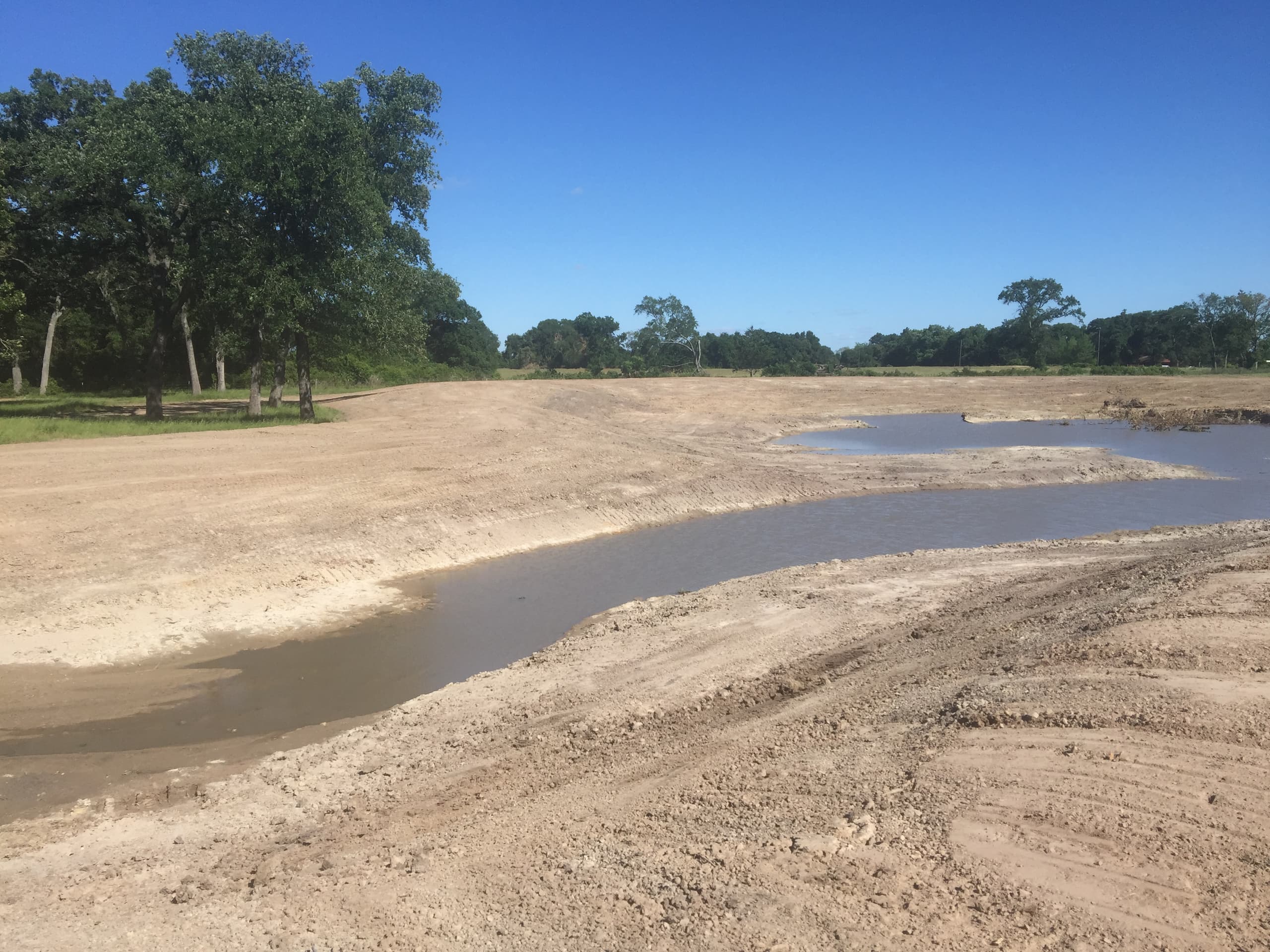
Commercial Detention Pond Construction in East Texas
Features
Excavated to Design Elevations
Pond bottom, side slopes, and top of bank are cut to the elevations on the drainage plan, because the pond's storage volume depends on them.
Compacted Embankments
Where the pond is held by an embankment, it's built in compacted lifts to the geotech's spec, not pushed up loose.
Outlet and Overflow Structures
Outfall pipe, headwalls, riprap, and the emergency spillway are built where and how the plan shows them.
Cut Material Put to Use
Suitable pond spoil can become fill for building pads and roads elsewhere on the site, which keeps export costs down.
Stabilized Before We Leave
Side slopes are dressed and stabilized as the plan calls for, so the first big rain doesn't wash the banks into the pond.
Experience with Commercial Ponds
We've built numerous commercial retention ponds, and we use the same fleet and crew that do our mass grading.
Why Commercial Sites Need Detention
When a site goes from woods or pasture to roofs and pavement, it sheds more water, faster. Many cities and counties require new commercial and subdivision projects to hold that extra runoff and release it no faster than the land did before development. The civil engineer designs a detention pond (which drains down after a storm) or a retention pond (which holds a permanent pool) to do that, and the drainage plan spells out its volume, elevations, slopes, and outlet.
Our job is to build exactly that. A pond that's a little shallow, a little steep, or has its outlet set at the wrong elevation doesn't hold or release the volume it was designed for, and that can show up at final inspection or the first big storm. These are engineered stormwater structures, not the farm runoff ponds we build for landowners.
How We Build a Detention Pond
We stake the pond from the plans, then excavate the basin to the design bottom and side slopes with our John Deere 350G and Caterpillar 320E excavators and John Deere 850K and Caterpillar D6N dozers. Where an embankment forms part of the pond, it goes up in compacted lifts to the geotechnical spec, with density tests coordinated through the project's testing lab. Outlet pipe, headwalls, riprap, and the emergency spillway are built to the plan's details and elevations.
Spoil from the basin is often suitable fill. On a site where we're also doing the excavation and grading, we use it for building pads and road subgrade instead of hauling it off. Slopes are dressed and stabilized as the plan specifies, and the site-wide swales that feed the pond follow the stormwater grading plan.
Stormwater Permits, Sequencing, and Bidding
Detention ponds are often built early, sometimes as a sediment basin during construction and then finished as the permanent pond, depending on the SWPPP. Permit coverage under TCEQ's construction stormwater general permit belongs to the project's operators, usually the owner or developer and the GC; we build and maintain the controls the SWPPP assigns to our work.
To bid, send the drainage plan and pond details, the geotechnical report, the SWPPP if it addresses the pond, and your schedule. We can bid the pond alone or as part of the full commercial site work package.
Frequently Asked Questions
What's the difference between a detention pond and a retention pond?
A detention pond holds stormwater temporarily and drains down after a storm. A retention pond keeps a permanent pool of water. Your civil engineer chooses the type in the drainage design, and we build either one to the plan.
Do you design detention ponds?
No. The pond is designed by your civil engineer as part of the drainage plan. We build it to the plan's volume, elevations, slopes, and outlet details.
Have you built commercial ponds before?
Yes. We've built numerous commercial retention ponds, using the same fleet and crew that do our commercial grading.
Can you build the pond as part of the rest of the site work?
Yes, and it usually saves money. Pond excavation often supplies fill for pads and roads elsewhere on the site, and one mobilization covers clearing, grading, the pond, and the slab.
Send Your Drainage Plan for a Bid
Send the civil drainage plan, pond details, geotech report, and schedule. We'll bid the pond on its own or with the rest of the site work. Questions? Call (936) 355-3471.